Platform

A platform approach to enterprise AI

AI1Q is built around a simple idea: separate data, AI capabilities, and applications so organisations can scale AI safely and repeatedly.

How it works

Connect data. Assemble a workflow. Deploy an application.

AI1Q is designed so teams can build real use cases without improvising security or rebuilding foundations for every new idea.

1) Connect your data

Bring in approved sources through plugin-based connections: databases, files, folders, URLs, and other controlled sources. You decide what’s available and to whom.

2) Assemble a workflow

Use a modular, visual workflow builder to compose how data, processing, and answers should work. This moves AI from ad-hoc prompting to something reusable and maintainable.

3) Deploy as an application

Deploy the workflow as a controlled internal application with access rules and isolation. It’s predictable for IT and useful for business teams.

Why it matters

Separation that makes AI safe to scale

Many solutions tightly couple data, models, and UI. That’s convenient early on, but it becomes fragile, hard to govern, and difficult to expand. AI1Q separates the layers so you can scale use cases without scaling risk.

Your data

Documents, databases, files, audio, images, and structured information remain under your control. You decide where data lives and how it is accessed.

AI capabilities

Semantic search, relevance scoring, entity recognition, and multilingual understanding are handled centrally and securely, so teams don’t reinvent the wheel.

AI applications

Use cases are deployed as workflows that combine data and capabilities in a controlled way. That’s how you get repeatability, auditability, and long-term maintainability.

Reference architecture

How the platform fits together

This diagram is a helpful way to understand how AI1Q separates sources, processing, AI services, and deployable applications. It’s intentionally modular so deployments can stay isolated and controlled.

AI1Q Platform Architecture

Open full diagram →
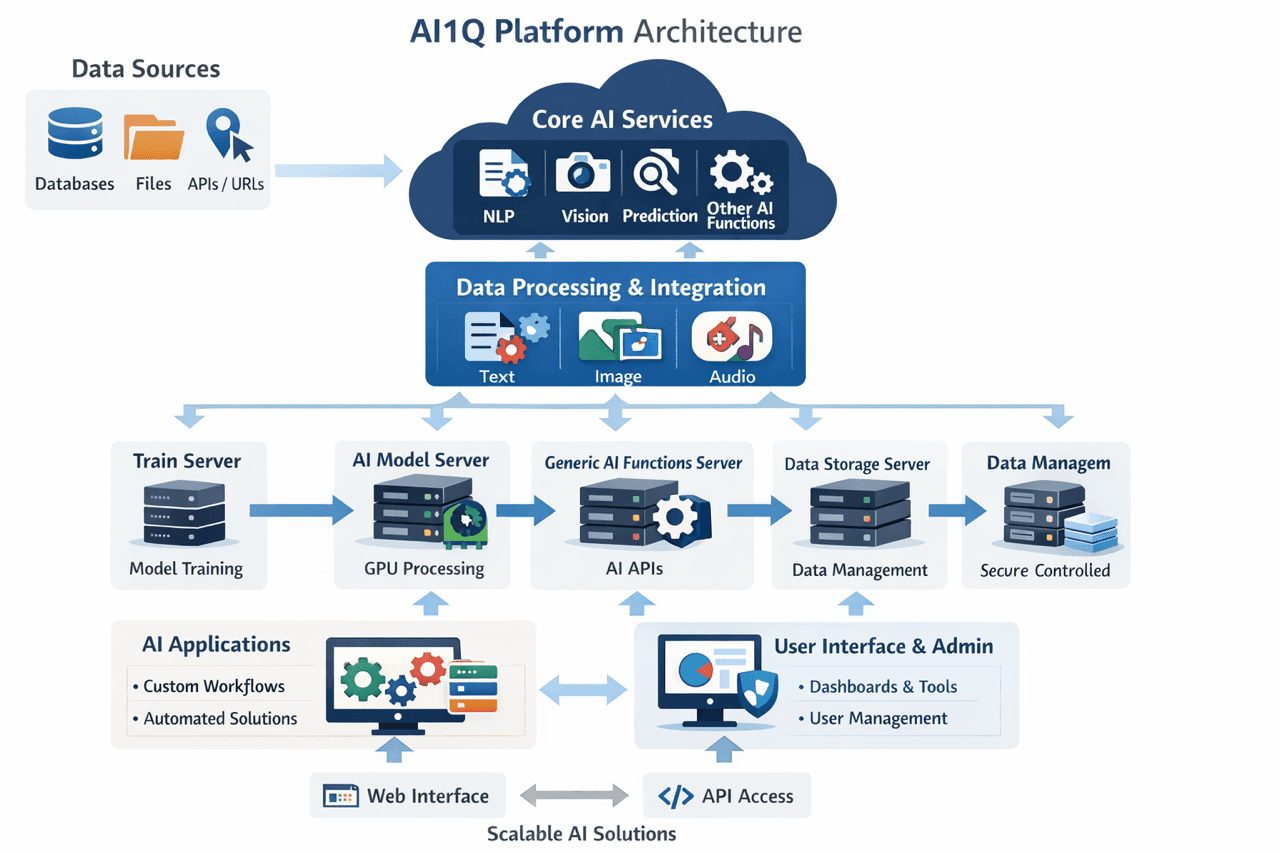
AI1Q Platform Architecture diagram

Note: Exact deployment topology can vary by environment and isolation requirements.

Capabilities

Built for real enterprise inputs

AI workflows only work when they can handle the messy reality of enterprise data: mixed formats, multiple sources, and multiple languages.

Multi-source and multi-format

Process PDFs (including scanned PDFs), DOC/DOCX, XLS/XLSX/CSV, images (OCR), audio (transcription/diarization), HTML and text.

Knowledge and semantic layer

Semantic search, relevance scoring, and entity recognition (person, organisation, place), with optional knowledge graph capability where it adds value.

Multi-language by default

Designed for Global realities: mixed-language sources, cross-language summaries, and Q&A without breaking governance boundaries.